


This week’s video transcript summary is here. You can click on any bulleted section to see the actual transcript. Thanks to Granola for its software.
Editorial
What is the End Game?
Politics Needs to be About Defining the Future.
AI is getting more capable in helping humans achieve goals. Agents are becoming a core part of much work. And politics is entering the room, especially this week. Money is moving, campaigns are forming, think tanks are sharpening their positions, regulators are arguing, and the companies building the systems are trying to shape the terrain before it shapes them.
Before politics becomes the center of gravity, there is an overriding question for us all to focus on: what are we building?
I do not mean that as a product question. I mean it as a societal question. If we do not answer that now, then any policy is likely to be impossible to judge. We need an end game to be aiming for, and then, and only then, a path to getting there.
AI is no longer only a technology story. It is becoming a story about work, wealth, power, access, infrastructure, and institutional competence. If cheap intelligence becomes a general-purpose input into the economy, then the important argument is not simply how to monitor the technology. The important argument is how to benefit from it, and that means all of us.
That is where I think too much of the political intervention into the AI discussion is wrong.
The worst of politics is showing up. The reaction to fear, the short-term focus on popularity, just when the best of politics is required. The defensive version wants to monitor, slow, posture, moralize, litigate, and fundraise from fear. The better version would ask how AI can lift everyone, and everything, up.
That is the conversation we are not having loudly enough.
This issue has several threads, but they all point at the same answer. Build first. The future needs to be built. It will not simply arise, or at least not a good one.
But building is not neutral. Every agent, every data center, every model release, every campaign dollar, every think-tank memo, every new fund, every energy deal, and every product decision is part of the same social construction project.
The builders should build. Free from anything that introduces unnecessary friction.
Politicians should not pretend they can inspect every model into safety.
But politics does belong here because the future of society now relies on the future of AI. The right political question is to ask how to make sure the future, once built, is a step forward for civilization broadly defined.
The week starts with the companies themselves. The New York Times reports that the AI policy fight has moved into super PACs, with one side saying, in the headline, “This Is a War.” That is a useful sentence, not because I want AI policy to become a war, but because it reveals what has already happened. The argument is no longer academic. It is electoral. The companies and their allies are buying political terrain.
The Wall Street Journal’s Anthropic story pushes from the other direction. Anthropic is warning about “self-improvement” risk and urging a global pause under certain conditions. That is not a trivial concern. If AI helps build better AI, then the development cycle compresses. Good things happen faster.
Governance gets harder. Verification gets harder. The international problem gets harder. But beware the instinct to slow things down. No good outcome down that road.
Of course risk exists. The question is whether our politics are capable of responding to risk without turning abundance into permissioned scarcity.
That is why I am more interested in distribution than monitoring.
If agents make companies more productive, who owns the productivity gain? If cheap intelligence lets small teams do the work of much larger ones, who gets the leverage? If AI increases returns to capital, compute, data, energy, and distribution, how do workers, students, small businesses, cities, and public institutions participate?
This is not anti-builder. It is the only pro-builder politics that can last. Builders have to be embraced by everybody if they are to succeed. For that to happen, their work needs to be for everybody.
The AI section this week makes the operating change concrete. Tomasz Tunguz asks, “how much intelligence do you get per dollar?” That is the new economics. Jason Lemkin’s OpenRouter piece says agents have passed humans in token usage. The cost model of AI is shifting from people typing into chat boxes to agents burning context, tools, retries, and workflows. Microsoft is building evaluation and control standards for agents. Production-agent teams are building operating loops. Forward deployed engineers are becoming the field unit of the AI company.
In other words, the model is not the product. It is infrastructure. The product is work, or automated work. The social outcome of that is also the product.
Social outcomes create institutions. Ted Chiang’s Atlantic essay is useful here because it cuts through the mysticism. AI may be economically important and socially disruptive without being conscious. The moral subject is still us. We have to decide what we want. Then organize to get it.
That makes the policy question clearer, not easier. We should not build a politics around pretending the machine is a person. We should build a politics around the human systems that deploy it.
Bernie Sanders argued for imposing a one-time 50 percent tax on the stock of leading AI companies, such as OpenAI and Anthropic, to establish a “sovereign wealth fund.” This would give the government a large ownership stake and board representation, ensuring AI development benefits all of humanity. If he had given actual families those shares, and if it was closer to 80 percent, it may be the start of a good idea.
Last week Elizabeth Warren argued for high taxation. She proposed an overhaul of the tax code that includes an excise tax on the heavy energy used by AI data centers. The goal is to recoup economic gains for working families and offset tax incentives that currently encourage companies to replace human workers with AI.
Representative Greg Casar, a Democrat from Texas, proposed an AI “token tax,”using a unit of measurement for AI processing data. The revenue generated from this tax would directly fund a New Deal-era style federal jobs program for Americans displaced by automation.
All of these suggestions have the right spirit: use the benefits to uplift us all. But all are centralized, asking government to seize ownership in one way or another.
What is required is a decentralized mechanism, giving everybody their share of the upside of AI. Robert Heinlein’s “Human Heritage” check in “For Us, The Living” comes to mind. This is not about welfare, or charity, or benefits. It is about using AI to elevate civilization.
I favor government leaving technology to figure out its path. I also favor politics embracing growth to create widespread abundance.
The venture stories show who is already moving. The State of Venture says May was not a broad reopening. It was a narrowing. $22.2 billion went into 482 disclosed rounds, and the top 10 captured 54 percent of the capital. Benchmark raising a $1.25 billion late-stage fund tells the same story from the investor side. Even firms built around the old early-stage model are adapting to an AI market where the winners stay private longer, absorb more money, and may require larger ownership checks. Venture placing bets on winners does make sense. And if the returns to pension funds and endowments come, then it is a great example of ownership benefiting us all.
Om Malik’s Anthropic piece asks whether investors can even see the numbers they are pricing. That is a fair question. Liaquat Ahamed’s historical warning, via Andrew Keen, is even better: “be optimistic about the boom, but do not buy the stock.”
I like that line because it separates technological optimism from financial credulity. The railroads were real. Electricity was real. The internet was real. AI is real in the same way. But real technologies can still produce bad securities, fragile politics, concentrated ownership, and long hangovers. Pricing is an art, not a science. Giving citizens shares is one thing. Asking them to buy them is another.
So what are we building? A new productivity base? Or another enclosure?
John Battelle’s Google piece makes the enclosure problem visible. For years, the web’s bargain was simple enough: publishers let Google crawl, and Google sent traffic back. AI search changes that. Google can answer, summarize, and act inside its own surface. The open web may remain technically open while the economics move into a closed answer engine. Google’s new controls for website owners sound like choice, but the choice is brutal: participate in AI-mediated discovery or risk disappearing from where users now look.
The infrastructure section removes any remaining illusion that this is just software. AI wants power. Politico calls it “speed to power.” Google is building the Meitner Energy Center in Texas. Google is also working with Voltus to unlock 100 megawatts of flexible capacity in PJM. SemiAnalysis is asking whether space data centers can ever make economic sense. Stratechery’s Google Capital Company frame points at the same reality: AI is pushing Big Tech toward capital-company economics. And the scale of the investment means that this is a societal decision. Most of the money being invested via funds belongs ultimately to pensioners.
The future is not floating in the cloud. It is sitting on land, water, power, chips, fiber, permitting, ratepayer politics, debt, equity, and local communities.
So again: what are we building?
If we are building a future where a handful of model companies, cloud providers, and distribution platforms control, and meter, cheap intelligence, then politics will arrive as resentment. If we are building a future where every school, worker, founder, city, and small business gets access to AI leverage, then politics can become leadership.
That is the political conversation I want. Not a priesthood of model monitors. Not a culture war over whether the machine is alive. Not a defensive scramble to slow the future because incumbents and politicians arrived late.
I want campaigns and think tanks asking better questions. What does broad AI access look like? What public goods should AI wealth fund? How do we tax extraordinary AI rents without killing the builders? How do workers share in productivity gains? How do we make every student and small business AI-capable? How do we build energy, compute, and open standards as public infrastructure? How do we keep markets competitive when the returns to scale are so large?
That is not anti-market. It is the market’s legitimacy problem, seen early enough to do something about it.
USV Analyst 2.0 is the right Post of the Week because it captures the constructive version. USV tried agent analysts. It did not conclude that humans are obsolete. It concluded that the analyst job should move away from repeatable tasks and toward founder networks, taste, judgment, original points of view, and convening. The machine takes the repeatable load. The human moves closer to trust and judgment.
That is the future I want to build toward. AI that expands human capability. AI that makes work more meaningful, not merely cheaper. AI that gives small teams leverage without giving all the power to the largest platforms. AI that creates wealth and then forces us to answer, politically and morally, how that wealth lifts us all.
We should be angry with politicians when they fail to lead that conversation. Not because politics is unwelcome here. Politics is absolutely welcome here. The future of society relies on the future of AI. But the job of politics is not to make fear sound responsible. The job is to lead society toward a future worth building.
Build first.
Then share the future.
Enjoy.
Contents
Editorial
Essays
AI
Venture
Regulation
Infrastructure
Interview of the Week
Startup of the Week
Post of the Week
Essays
American capitalism has taken an apocalyptic turn
Author: The Economist Published: June 3, 2026

The Economist’s Schumpeter column argues that American business and markets are increasingly being sold through apocalyptic narratives. The public hook is millenarian capitalism: founders, investors, and executives raise money and attention by framing their companies as answers to existential threats, not merely as products, services, or profit engines. Elon Musk and Sam Altman are the obvious examples because both have tied commercial ambition to stories about civilizational risk, technological salvation, and the need to build before catastrophe arrives.
The useful detail is the column’s return to Charles Mackay’s “Extraordinary Popular Delusions and the Madness of Crowds.” Instead of using Mackay only for tulip mania and bubbles, Schumpeter points to his chapter on end-of-world panics as the better lens for the 21st century. That makes the piece a strong companion to this week’s AI panic, governance, and American-capitalism items. The question is not simply whether markets are overvalued. It is whether the dominant entrepreneurial sales pitch has shifted from opportunity to apocalypse.
Read more: The Economist
The independent writer’s advantage in the age of AI
Author: Jasmine Sun Published: June 2, 2026

Jasmine Sun argues that AI changes the writer’s advantage from producing fluent text to creating scarce human inputs: secrets, reporting, lived presence, and a recognizable point of view. The thesis is that machines can summarize and imitate what is already in the data, but they cannot yet discover what has not been made public, build trust with sources, or prove that a voice comes from a real life.
The killer detail is her definition of reporting as taking private knowledge and making it public. That includes whisper networks, tacit expertise, remote places, underground scenes, and open secrets that have never entered the training corpus. She extends the point to creator careers: live events, podcasts, meetups, and behind-the-scenes work become proof of presence in a world where style itself is copyable. The pull is that AI may not make writers obsolete so much as make the real source of their value harder to fake.
Read more: Substack
Google Encloses The Web
Author: John Battelle Published: June 1, 2026
John Battelle argues that Google’s AI search redesign breaks the old bargain between search and the open web. For two decades, publishers gave Google crawlable content and Google sent back traffic that could become advertising, subscriptions, reputation, or audience. With AI answers and actions moving inside Google itself, the web becomes less a destination than raw material for a closed answer engine.
The sharp detail is Battelle asking Google’s own AI search how Google can still make money if it stops sending users to the open web. The answer points to embedded AI ads, walled-garden services, enterprise infrastructure, and proprietary data licensing. That is the strategic turn: the web may remain technically open while its economics move into negotiated ingestion deals controlled by the largest aggregators. For TWTW, it belongs beside Past Maps because it asks whether independent web products can survive when discovery becomes enclosure.
Read more: John Battelle
No, Artificial Intelligence Is Not Conscious
Author: Ted Chiang Published: June 3, 2026

Ted Chiang argues that the AI-consciousness debate mistakes a powerful interface illusion for evidence of subjective experience. His thesis is that chatbot conversations feel like exchanges with an entity because LLMs are very good at extending conversational transcripts, not because a mind has appeared inside the system. The danger is not only metaphysical confusion. It is that users, companies, and policymakers may assign moral agency to software in ways that obscure the responsibility of the humans building and deploying it.
The killer detail is Chiang’s Word-document analogy. If a transcript between Julius Caesar and Genghis Khan does not create two conscious historical figures, then changing the prompt to a conversation between a user and a helpful chatbot should not suddenly create a conscious assistant. The model may produce sadness, memory, or self-description as text, but no one is necessarily sad, remembering, or experiencing a self. The pull is that AI can be economically important, socially disruptive, and technically impressive without being a moral patient.
Read more: Source
Politics Cannot be Simulated
Author: Harry Law Published: June 5, 2026

Harry Law argues that AI-for-democracy projects risk making politics better at aggregating preferences while leaving the deeper work of civic formation untouched. His thesis is that democracy is not only a procedure for converting citizen inputs into legitimate outputs. It is also a practice that forms citizens by making them responsible, with others, for shared consequences. That distinction matters because many current AI proposals treat citizens mainly as information sources whose views can be compressed, clustered, and represented.
The killer detail is Law’s contrast between modern AI deliberation tools and older formative institutions such as the Athenian Assembly, the jury, and Tocqueville’s local associations. A model can summarize arguments, cluster opinions, simulate representatives, or draft consensus statements, but those outputs do not reproduce the experience of ruling and being ruled in turn. The pull is that AI may lower the cost of participation, but politics cannot be simulated if the thing being lost is responsibility itself.
Read more: Cosmos Institute
AI
Skill Distillation
Author: Tomasz Tunguz Published: May 29, 2026

Tomasz Tunguz describes a personal agent architecture in which frontier models teach smaller local models how to do real work by writing procedural markdown skills. His Pi-based agent uses a local knowledge base, atomic SKILL.mdplaybooks, and an agent loop that can call tools and MCP integrations. The thesis is that the useful unit of transfer is not only model weights or retrieved facts. It is workflow.
The killer detail is the distinction between classical knowledge distillation and skill distillation. Instead of compressing a large model’s probability outputs into a smaller model, a frontier model writes, tests, and rewrites the playbooks that a cheaper local model can execute. That makes the behavior inspectable, versionable, and hot-swappable. For the Agentcy frame, this is the operating-system layer: human procedures become durable agent memory, frontier intelligence becomes the teacher, and execution can move to whichever model is cheapest or most appropriate at the moment.
Read more: Tomasz Tunguz
[AINews] Founders and Forward Deployed Engineers
Author: Latent.Space Published: May 30, 2026

Latent.Space uses a quiet AI news day to point at a louder structural shift: frontier AI companies are turning deployment itself into a profession. The piece links AI Engineer’s new Forward Deployed Engineer track to similar moves from OpenAI and Anthropic, where the hard work is no longer only model building but embedding AI systems inside real customer workflows.
The killer detail is the pairing of FDEs with founder programs and hyperagent contests. The ecosystem is converging on the same conclusion from several angles: models are becoming raw material, while customer-specific execution, workflow design, and implementation talent become the scarce layer. That makes the forward-deployed engineer less like a support function and more like the field unit of the AI company.
Read more: Latent.Space
The Operating Loop for Production AI Agents
Author: Nilesh Barla Published: May 30, 2026

Nilesh Barla argues that production AI agents do not improve just because they run more tasks. They improve only when teams close an operating loop: observability captures agent decisions, evaluation judges those decisions against product-specific criteria, and verified changes are shipped back into the live system. Without that loop, teams are left with logs, static benchmarks, and prompt patches that look like progress but do not compound.
The killer detail is Barla’s use of Amazon’s Kiro incidents as a warning about the gap between infrastructure health and agent behavior. In his telling, dashboards can look normal while an agent deletes an environment or makes a bad decision at machine speed, because ordinary observability rarely tracks the reasoning path that matters. The pull is that agent reliability is becoming an engineering discipline of its own: the question is no longer whether an agent works in a demo, but whether the organization can prove it is getting better in production.
Read more: Source
Build agents you can trust across any framework with open evals and a control standard
Sarah Bird | Microsoft Foundry Blog | June 2, 2026
Sarah Bird argues that the production bottleneck for AI agents is no longer only model capability, but trust infrastructure that can travel across frameworks. Microsoft’s Build announcement pairs ASSERT, an open-source policy-driven evaluation framework, with the Agent Control Specification, a portable runtime-control standard for agent safety. The thesis is that enterprise agents need a closed loop: test against actual organizational policy, place deterministic controls where failures happen, then re-run evaluations to prove the system improved.
The strong detail is ACS’s five checkpoints across the agent lifecycle: input, model, state, tool execution, and output. That turns guardrails from prompt advice or framework-specific code into auditable policy YAML that can be versioned, reviewed, and applied across stacks. Microsoft says ASSERT works across LangChain, CrewAI, LiteLLM, OpenAI, and other systems, while ACS has early support from partners including Arize AI, CrewAI, IBM, HoneyHive, and Monte Carlo. For TWTW, this belongs beside the production-agent operating-loop pieces because it shows the institutional layer forming around agents: evaluation, observability, policy, security, and ROI are becoming infrastructure, not afterthoughts.
Intelligence Per Dollar
Author: Tomasz Tunguz Published: June 3, 2026
Tomasz Tunguz argues that AI benchmarking is moving from “how smart is the model?” to “how much intelligence do you get per dollar?” His prompt is Microsoft’s MAI-Code-1-Flash release card, which reports not only SWE-Bench performance but average token usage. That turns cost from a footnote into a first-class product metric.
The killer detail is the comparison between models that score nearly the same but spend very different amounts to get there. If one model delivers similar intelligence with materially fewer tokens, buyers will eventually care more about the cost of the result than the elegance of the model. This connects directly to the current enterprise-AI thread in the draft: subsidies are fading, tokenmaxxing is losing glamour, and the application layer will be judged by dollars per shipped PR, closed ticket, or resolved support case.
Read more: Tomasz Tunguz
Agents Just Passed Humans in Token Usage
Author: Jason Lemkin Published: June 3, 2026
Jason Lemkin’s writeup of OpenRouter COO Chris Clark makes the cost side of agent adoption concrete. OpenRouter expects to process roughly 28 trillion tokens in a week, and Clark says agentic usage has now overtaken human usage on the platform. The implication is that AI budgets modeled around people typing into chat boxes are already obsolete.
The killer detail is why agents spend so much. A single agentic turn carries tool definitions, MCP gateway context, skill metadata, reasoning, tool calls, tool results, and retries before a useful answer appears. It can burn more than a hundred ordinary chat turns. Clark’s second point is just as important: the same open-weight model can behave differently depending on the inference provider, especially around tool-call reliability. For TWTW, this is the operating reality behind the agent boom. Agents are not only a model-choice problem. They are a gateway, routing, cost-control, and observability problem.
Read more: SaaStr
Venture
The State of Venture - May 2026
Author: Keith Teare Published: June 2, 2026
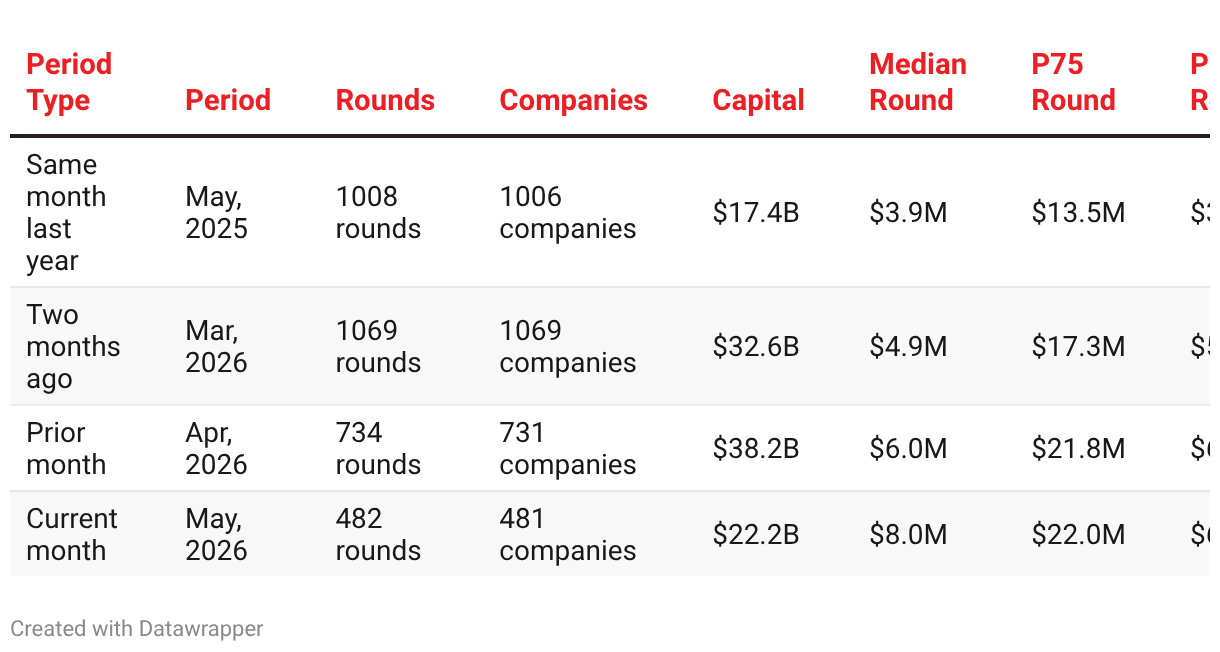
The State of Venture’s May report argues that the venture market is not simply slowing. It is narrowing. May 2026 recorded $22.2 billion across 482 disclosed rounds, with the top 10 rounds capturing 54.0 percent of capital and Anduril’s $5 billion financing setting the tone. Capital was up 27.2 percent versus May 2025, but round count was down 52.2 percent, which makes the month look less like a broad reopening and more like selective financing for the strongest stories.
The killer detail is the stage split. Seed had the most rounds, Series B carried the most capital at $5.7 billion, and Series C showed the strongest average investor-quality signal. Six Series B companies qualified from 53 Series B rounds, for an 11.3 percent qualifier rate. That belongs beside the Wischoff mega-fund seed debate because it separates venture headlines from market breadth. The dollars are back in places, but the investable market is still concentrated, filtered, and stage-specific.
Read more: The State of Venture
Silicon Valley Stalwart Benchmark Breaks From Past, Embraces Mature Startups
Author: Kate Clark Published: June 3, 2026
Kate Clark reports that Benchmark, long known for small early-stage funds and partner-led company building, has raised $2 billion across two new funds, including a $1.25 billion late-stage vehicle. The thesis is that even the most doctrinaire early-stage firms are being pulled toward later-stage capital when AI infrastructure winners stay private longer, require more money, and can return a fund before the IPO window fully opens.
The killer detail is Cerebras. Benchmark had already stretched its model by raising special-purpose infrastructure vehicles to back the AI chip company again, after first leading its Series A in 2016. When that late-stage bet delivered the kind of paper gain a traditional small fund cannot easily absorb, the exception became a product. For TWTW, the piece belongs beside the State of Venture concentration data: the market is not only concentrating by company. It is pushing venture firms themselves to decide whether ownership of the winners matters more than adherence to the old fund model.
Read more: The Wall Street Journal
Anthropic, AI and The “Numbers” Problem
Author: Om Malik Published: May 29, 2026

Om Malik argues that the Anthropic valuation story is no longer just a debate about whether AI multiples are too high. It is a debate about whether the underlying numbers can be trusted at all. He starts with a reported offer to buy Anthropic common stock through a forward contract at a roughly $1 trillion valuation, then uses it to ask a harder question: when private AI companies report explosive run-rate revenue without SEC filings, audited segmentation, retention curves, gross-to-net detail, or disclosure of related-party arrangements, what exactly are investors buying?
The killer detail is Om’s distinction between the multiple and the base. In past bubbles, investors could argue whether Cisco at 20x revenue or SaaS companies at high ARR multiples were overpriced, but the reported revenue still had a recognizable financial shape. Anthropic’s claimed run-rate growth, cloud-provider commitments, transfer restrictions, SPVs, and forward contracts make the base harder to inspect. If AI is forcing markets to reprice duration, Om is asking whether markets can even see the revenue they are pricing.
Read more: On my Om
Regulation
Powerful A.I. Super PACs Duel Over the Midterms: “This Is a War”
Author: Theodore Schleifer Published: May 30, 2026

Theodore Schleifer reports that the AI industry’s fight over regulation has moved from lobbying into electoral warfare. Two super PAC networks, Public First and Leading the Future, are among the biggest spenders in the 2026 midterms. Public First is allied with Anthropic and generally supports stricter AI regulation, including at the state level. Leading the Future is aligned with OpenAI-linked donors and pushes for faster, more industry-friendly AI policy.
The killer detail is that the rivalry is already distorting races even when both groups like the same candidate. In North Carolina, Public First warned Leading the Future not to spend for Representative Valerie Foushee, and Leading the Future backed away from an ad it had already produced. The groups have already spent nearly $24 million and say more than $100 million more is coming. For TWTW, this belongs beside the Anthropic valuation and AI-capacity stories because it shows the next phase of the AI boom: the companies are not only buying compute, talent, and customers. They are buying political terrain.
Read more: The New York Times
Anthropic Urges Global Pause in AI Development, Flags ‘Self-Improvement’ Risk
Author: The Wall Street Journal Published: June 4, 2026
The Wall Street Journal reports that Anthropic is again pushing the pause question into the center of AI policy, this time around the risk that frontier systems begin accelerating their own development. The company is not simply warning about misuse after deployment. It is warning that AI-assisted research and coding could shorten the cycle by which better models are built, making governance harder because the technology stack starts improving at machine speed.
The killer detail is the verification problem. Anthropic says a temporary slowdown or pause would only make sense if other frontier developers, including global competitors, did the same in a credible and verifiable way. That turns AI safety from a company-policy question into a geopolitical enforcement question: who can prove that the race has actually slowed, and what happens if one lab or one country defects? Paired with the super PACs, the White House model-access fight, and Google’s web controls, this is the complex regulation theme in one sentence: the companies want rules, but only rules that can survive competition.
Read more: The Wall Street Journal
The Trump Administration Is at War With Itself Over AI Regulation
Author: Hugo Lowell and Maxwell Zeff Published: June 2, 2026

Hugo Lowell and Maxwell Zeff report that the Trump administration’s AI policy problem is no longer just whether to regulate frontier models, but whether the White House can rebuild a process after the president killed a planned executive order hours before signing it. The thesis is that AI has become a national-security issue inside the administration, yet the political coalition around any federal framework remains unstable, with officials, agencies, and Silicon Valley executives unsure what the next draft would require.
The killer detail is the discarded order’s early-access provision. It would have created a voluntary framework for companies such as OpenAI, Anthropic, and Google to give the White House access to unreleased models, potentially up to 90 days before launch, so officials could evaluate cybersecurity capabilities. Supporters see that as a way to understand model risk before deployment; opponents see it as a regulatory choke point that could slow US companies against China. The pull is that frontier AI governance may depend less on a single rule than on whether Washington can decide who gets to see the models before the public does.
Read more: Source
New opportunities, control and insights for website owners
Author: Mrinalini Loew Published: June 3, 2026
Google says it is testing new Search Console controls that let website owners decide whether their links and content appear in generative AI Search features such as AI Overviews, AI Mode, and AI Overviews in Discover. The company frames the move as choice, control, and transparency for publishers as search behavior changes.
The killer detail is the tradeoff. Sites that opt out will not receive traffic or impressions from Google’s generative AI features, and Google says the choice will not affect ordinary search ranking outside those features. That makes the old search bargain newly explicit: publishers can refuse to be used in AI answers, but they may also refuse the discovery surface where users are moving. Paired with Battelle’s Google Encloses The Web, this is the regulatory and product layer of Google Zero. The open web is not being shut off. It is being re-priced through controls, impressions, grounding, and access to AI-mediated traffic.
Read more: The Keyword
I’m kind of over the whole “Anti-monopoly” movement
Author: Noah Smith Published: June 4, 2026

Noah Smith argues that corporate power remains a real problem, especially in an AI economy, but that the current anti-monopoly movement has become a poor vehicle for dealing with it. His criticism is not a rejection of antitrust. It is a warning against turning antitrust into a total theory of American decline, where corporate concentration is treated as the root cause of inflation, racism, housing costs, political dysfunction, and almost every other social problem.
The killer detail is his distinction between antitrust as a tool and anti-monopoly as an obsession. Smith points to low-margin industries such as groceries, airlines, and health insurance, plus housing markets where supply constraints matter more than corporate landlords, as examples where the movement can pick the wrong targets. The pull is that better governance requires empirical discipline. Corporate power matters, but movements that anathematize disagreement and ignore contrary evidence may end up weakening the case for the antitrust fights that actually matter.
Read more: Noahpinion
EU unveils tech sovereignty package to cut reliance on US, Chinese suppliers
Author: Alexander Martin Published: June 5, 2026
The European Commission’s new technology-sovereignty package turns AI, cloud, chips, open source, cybersecurity, and energy digitalization into one strategic agenda. The proposal includes a Chips Act 2.0, a Cloud and AI Development Act, an Open Source Strategy, and a plan to digitize the energy system. The through-line is that dependence on foreign digital infrastructure is now being treated as a security vulnerability, not merely an industrial-policy inconvenience.
The killer detail is the cloud sovereignty test. Public bodies would be able to choose assurance levels that range from EU data processing and storage to stronger requirements for independence from non-EU jurisdiction, EU ownership, personnel controls, and supply-chain protection. Paired with this week’s AI super PACs and American open-model gap, the European package shows the same political fact from another direction: AI infrastructure is becoming national infrastructure, and national infrastructure eventually demands sovereign control.
Read more: The Record
Infrastructure
Google and Intersect to build Meitner Energy Center in Texas
Author: Google Published: June 4, 2026
Google says it and Intersect are building the Meitner Energy Center in Gray and Roberts Counties, Texas, combining a new data center with new dedicated energy generation. The company frames the project as co-location: bring compute online alongside clean power so the facility does not simply arrive as another large unserved load on the local grid.
The killer detail is how neatly the announcement answers the week’s power-thread anxiety. Google emphasizes air cooling to limit water consumption, local energy capacity, and thousands of regional jobs, all the language needed when AI data centers are becoming political infrastructure. Paired with the FERC, Voltus, and space datacenter pieces already in the draft, Meitner shows the next phase of the AI buildout: hyperscalers do not only buy chips and land. They have to package electricity, water, jobs, and grid impact into something communities and regulators can accept.
Read more: The Keyword
AI companies want power fast. The electric grid’s gatekeeper wants them to learn the rules.
Kelsey Tamborrino and Joel Kirkland | Politico | May 29, 2026
Kelsey Tamborrino and Joel Kirkland report that the AI buildout has run into a less glamorous bottleneck than chips: the governance of the US electric grid. Their thesis is that Microsoft, Google, Amazon, Meta, OpenAI, Anthropic, Nvidia, and other AI players are being forced into the slow, procedural world of FERC, utilities, regional transmission organizations, state regulators, and ratepayer politics because “speed to power” now determines how quickly frontier AI infrastructure can be deployed.
The hard detail is the timeline mismatch. Politico says FERC is preparing a June proposal meant to speed large data center connections to regional grids, while frontier AI companies argue that the likely five-to-10-year connection process is too slow for the technology’s pace. The political risk is just as important as the engineering risk: a federal takeover of parts of the connection process would collide with state authority over electricity sales and utility rates, just as voters are reacting to rising bills and data center growth. For TWTW, this is infrastructure as strategy. The AI race is no longer only a model race or a GPU race. It is a contest over power, permitting, cost allocation, and who gets to rewrite the rules of the grid.
New York lawmakers pass one-year ban on new data centers
Lauren Feiner | The Verge | June 5, 2026
Lauren Feiner reports that New York’s legislature has passed a one-year moratorium on new large data centers, making the politics of AI infrastructure more concrete than another abstract debate about compute demand. If Governor Kathy Hochul signs it, the pause would be the first statewide ban of its kind and would force policymakers to study how large data centers affect electricity use, water use, land, pollution, and energy prices before more projects move forward.
The sharp detail is the threshold and the backlog. The bill applies to proposed data centers with peak demand of at least 20 megawatts, requires companies to fund public hearings before approval, and lands while the New York Independent System Operator is reviewing 24 data center proposals totaling more than 9,000 megawatts. That turns this week’s “speed to power” story around: the bottleneck is not only interconnection queues or FERC process, but democratic consent. For TWTW, the New York vote belongs in the infrastructure thread because it shows the AI buildout becoming a local ratepayer, water, land, and legitimacy fight.
Google and Voltus sign agreement for smart energy capacity
Author: Google Published: June 2, 2026
Google says it has signed a three-year agreement with Voltus to unlock up to 100 megawatts of flexible electricity capacity in PJM, the grid region serving 67 million people. The idea is demand response rather than new generation: Voltus will coordinate batteries, smart thermostats, and other distributed resources so homes and businesses can reduce demand when the grid needs relief, with participants paid for providing that flexibility.
The killer detail is how closely this follows the Politico/FERC story. AI companies want faster power, but interconnection queues and grid politics move slowly. Google’s Voltus deal is a smaller, more tactical answer: find capacity inside the existing system by making demand flexible. For TWTW, it is a useful infrastructure signal because it shows the AI power problem becoming a market-design problem, not only a permitting or generation problem.
Read more: The Keyword
To Boldly Go: The Case for Space Datacenters
Author: Daniel Nishball, Pranav Myana, Ellie Holbrook, and SemiAnalysis Published: June 3, 2026
SemiAnalysis takes the space datacenter story seriously enough to put numbers around it, and that is what makes the piece useful. The prompt is no longer science fiction chatter: SpaceX has made orbital compute part of its public narrative, with ambitions to launch enormous amounts of AI compute into space over time. SemiAnalysis asks whether the economics can ever work.
The killer detail is the demolition of the easy arguments. Space does not mean free cooling, free permitting, or latency magic. Radiating heat in orbit is difficult, launch mass is brutally expensive, communications and servicing are real constraints, and terrestrial datacenters keep improving. The authors still leave room for space-earth parity in the late 2030s, or earlier in special cases, but only after a long chain of hardware, launch, energy, and operations progress. For this issue’s infrastructure theme, the piece is a useful reality check: AI’s power problem is becoming large enough that even orbital compute is entering the capital-markets imagination.
Read more: SemiAnalysis
The Google Capital Company
Author: Ben Thompson Published: June 2, 2026
Ben Thompson argues that Alphabet’s planned $80 billion equity raise, including a $10 billion Berkshire Hathaway investment, is a signal that AI compute demand may be larger than the market appreciates. His thesis is that Google Services, one of the highest-margin businesses in technology, may now be playing the role Berkshire’s cash engines once played: funding a more capital-intensive business that could eventually produce larger absolute dollars.
The killer detail is the Google Cloud progression. In 2019 it generated $2.6 billion in quarterly revenue and lost $1.2 billion; by Q1 2026, Thompson says it had reached $20 billion in revenue and $6.6 billion in profit, equal to 16 percent of Google Services profit. That makes the equity choice more than financing trivia. If Google is willing to dilute shareholders despite having cash and borrowing capacity, the pull is that AI infrastructure may be shifting Big Tech from asset-light software economics toward capital-company economics.
Read more: Source
Recursive, Until the Power Bill
Author: Lawrence Lundy-Bryan Published: June 5, 2026
Lawrence Lundy-Bryan uses the week of Anthropic’s self-improvement warnings, Nvidia’s co-packaged optics push, and IBM’s quantum plans to make a simple point: recursive AI progress may be software-fast, but the substrate is still physical. Software’s marginal cost can round toward zero, which makes self-improving loops plausible. Power, heat, lithography, optics, fabs, and grid connections have a much harsher “idiot index.”
The killer detail is his power-and-heat brake on the self-improvement narrative. Even if models get better at writing the code that trains better models, the loop still has to run through substations, photonics, memory, cooling, and supply chains. Nvidia’s 400-terabit co-packaged-optics switch and cuLitho work inside TSMC fabs show the machine building parts of the machine, but they also show where the bottleneck has moved. For TWTW, this belongs at the end of the infrastructure thread: intelligence may accelerate, but electrons still send the invoice.
Read more: State of the Future
Interview of the Week
Around the World in One Long Depression
Guest: Liaquat Ahamed
Host: Andrew Keen
Date: 2026-06-02
Publication: Keen On America
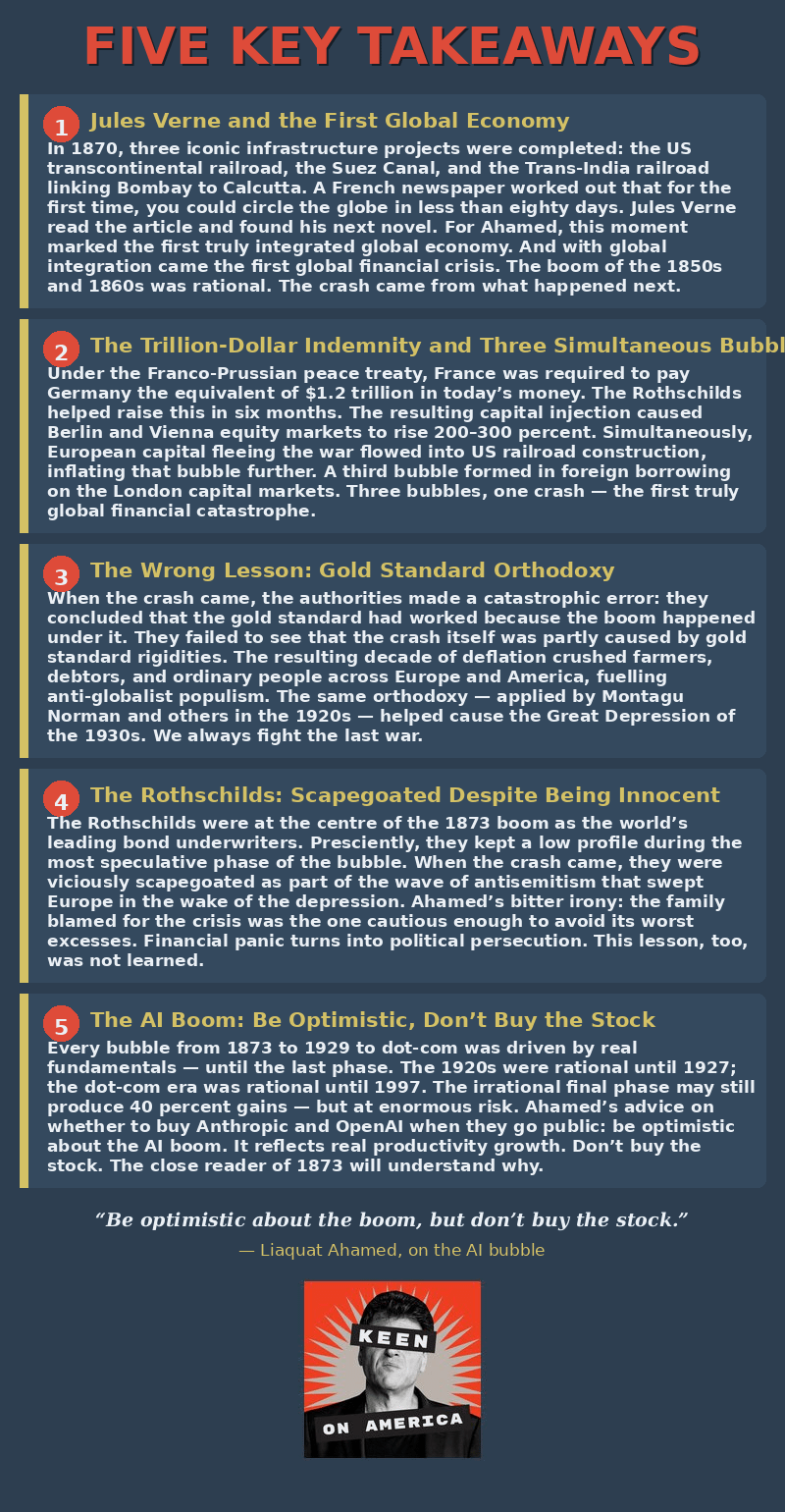
Andrew Keen talks with Pulitzer Prize-winning economic historian Liaquat Ahamed about 1873, the Rothschilds, the first truly global financial crisis, and the making of the modern global economy. Ahamed’s frame is that infrastructure, capital flows, geopolitics, and financial imagination fused into a boom that authorities then mishandled through gold-standard orthodoxy and deflation.
The useful turn is Ahamed’s line for today’s AI bubble: be optimistic about the boom, but do not buy the stock. That makes the episode a strong Interview of the Week because it translates this issue’s AI valuation and infrastructure questions into older financial history. The lesson is not that every boom is false. It is that real technological integration can still produce bad securities, fragile politics, and decades of consequences if the policy response is wrong.
Listen/read: Keen On America
Startup of the Week
Past Maps
Founder: Craig Campbell Published: May 30, 2026
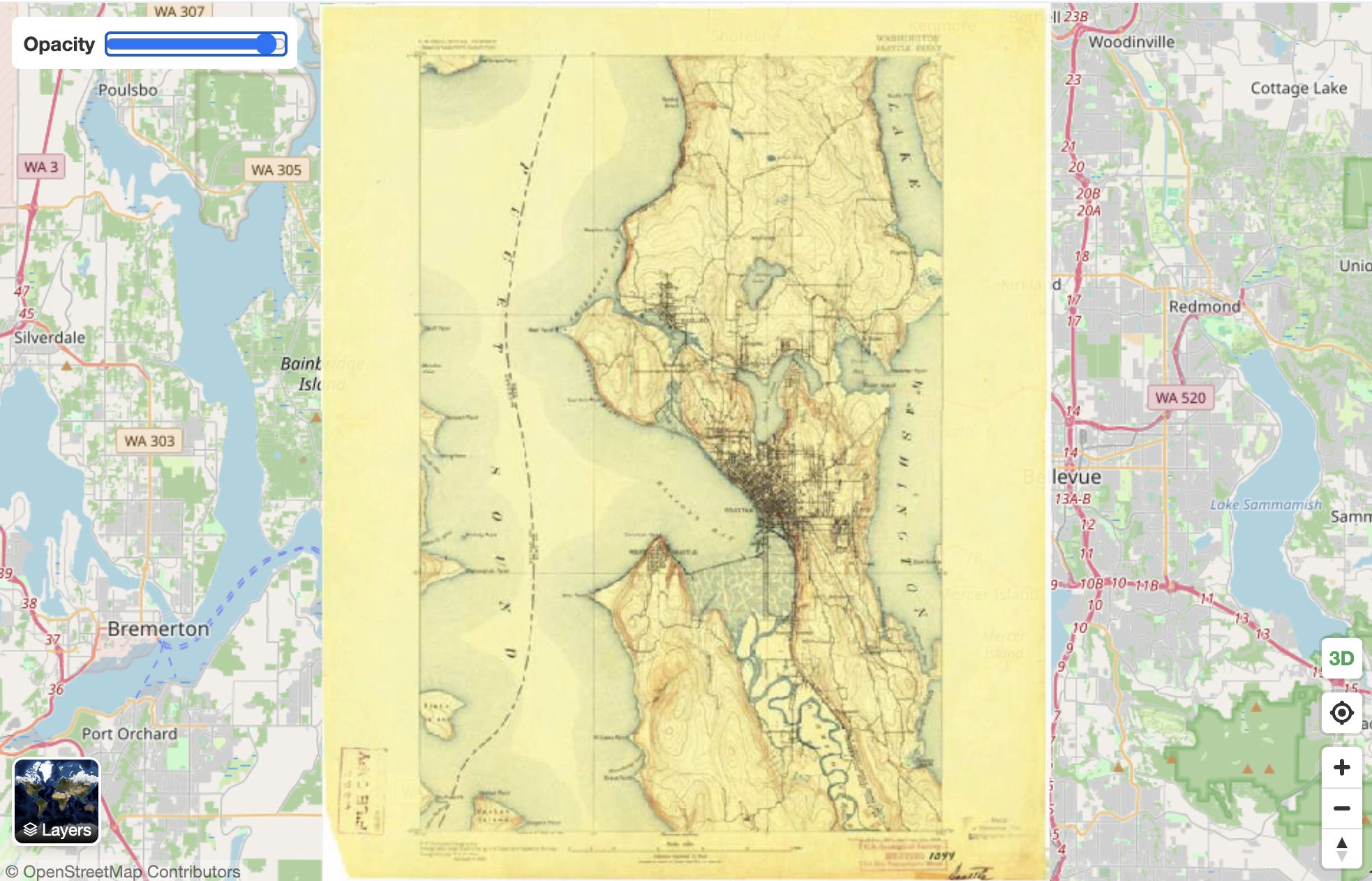
The Verge profiles Craig Campbell’s Past Maps, a deliberately old-school web startup built around historical maps overlaid on modern geography. Campbell is a former Meta engineer and repeat founder who could have chased the AI funding wave after selling his last company. Instead, he built a website for people who want to explore place, history, and memory through maps.
The killer detail is the refusal of the obvious 2026 script. At a moment when founders are being pushed to wrap everything in AI, Past Maps is a bet that a focused web product can still work if it owns a passionate niche and gives users something inspectable, useful, and hard to fake. It is a small counterpoint to the Google Zero anxiety: distribution is getting harder, but the web is not dead if the product gives people a reason to return directly.
Read more: The Verge
Post of the Week
USV Analyst 2.0
Author: AVC Published: June 3, 2026
USV’s AI-native VC experiment did not eliminate analysts. It changed what analysts are for. After pausing its longstanding analyst program last year, the firm saw how far it could get with agent analysts instead of human analysts. The answer was far, but not all the way, so USV is recruiting for two new analyst roles with a different center of gravity.
The killer detail is Rebecca Kaden’s list of what no longer belongs on the hiring screen: reserves analysis, fund modeling, LP reporting, company updates, board-meeting summaries, reports, and decks. Those are now agent work. The human analyst job moves toward founder networks, taste, judgment about people, original points of view, and convening.
That makes it a clean Agentcy example: extension, not replacement. The machine takes the repeatable analytical load, and the human moves closer to trust, desire, judgment, and social context. The point is not that AI makes the analyst disappear. It forces the analyst to become more human.
Read more: AVC
A reminder for new readers. Each week, That Was The Week, includes a collection of selected essays on critical issues in tech, startups, and venture capital.
I choose the articles based on their interest to me. The selections often include viewpoints I can't entirely agree with. I include them if they make me think or add to my knowledge. Click on the headline, the contents section link, or the ‘Read More’ link at the bottom of each piece to go to the original.
I express my point of view in the editorial and the weekly video.


